

-
مختلط الألوان
-
أزرق/أبيض


-
ألوان متعددة
-
ألوان متنوعة
-
مختلط الألوان


Best Headphones for Homeschool Co-ops: A 2026 Buyer‘s Guide
A homeschool co-op is not a small school. The headphones shouldn't be purchased like one, either.
A school buys headphones through a purchase order. A co-op buys them through a group text, a treasurer with a spreadsheet, and at least one parent asking, “Do we really need 24?”
That difference matters. Co-ops are parent-run, budget-sensitive, and often smaller than a single classroom. The headphones have to fit the way co-ops actually operate: shared among families, stored between meeting days, and paid for from a pool of fees that everyone can see.
Here's what to look for when buying headphones for a homeschool co-op — and how the KEEWONDA 24-Pack can work for a group that may not need all 24 units at once.
Why Co-op Headphone Buying Is Different
A co-op shares teaching labor and costs. Families pool fees to cover facility rental, insurance, and supplies, and the budget is usually published and transparent. That creates three constraints a school purchase doesn't have:
① The budget is collective and visible
Every dollar spent on headphones is a dollar not spent on curriculum or a field trip. The treasurer will ask why 24 is better than 12.
② The group may be smaller than a classroom
Informal co-ops often run 3–12 families, and even structured co-ops may have one or two classes rather than a full grade level. A 24-pack can feel oversized.
③ Hygiene is a parent-to-parent issue, not just a facilities issue
When supplies are shared among families, parents want to know where a headphone has been and who used it last. Individual packaging matters more when the person handing it out is another parent, not a lab aide.
The Co-op Headphone Checklist
① Wired 3.5mm connection
Co-op classes often meet in borrowed spaces — church rooms, community centers, a parent's basement. The devices may be a mix of family laptops, donated Chromebooks, and tablets.
A wired 3.5mm jack works with all of them without pairing, charging, or asking a volunteer to troubleshoot Bluetooth. For a deeper look at why wired wins in group settings, see our guide to best bulk headphones for schools.
② Hardware-based 85dB volume limit
Co-op classes mix ages. A 6-year-old and a 12-year-old may use the same headphone on the same day, and the parent volunteer may not be watching every volume slider.
A fixed hardware 85dB limit protects younger ears without requiring the parent-teacher to monitor settings. It's built into the headphone, not the device. For the full explanation of hardware vs. software limits, see: Why 85dB Volume-Limited Headphones Are Non-Negotiable for K-12.
③ Individually bagged — for parent-managed sharing
In a co-op, headphones may go home with a family between meeting days, or stay in a storage bin until the next class.
Individually bagged headphones give co-op organizers a simple system:
- Each family can be assigned a bag (or a color) for the semester
- Unused units stay sealed and clean between meetings
- A parent can see at pickup whether their child's headphone came back in its bag
- Replacement is per-unit, not per-set
This is not a medical claim. It's a practical way to reduce cross-contact and make shared supplies easier to track. For a deeper discussion, see: School Headphone Hygiene: Why Individually Bagged Matters.
④ Color coding for family or class assignment
Co-ops often organize by family or by age band, not by row or station.
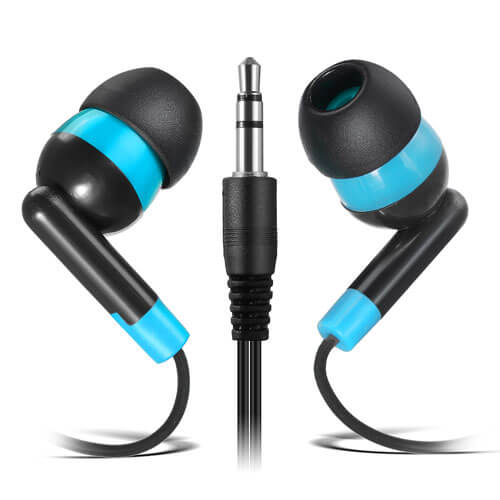
Four colors — Black, Orange, Green, Cyan — let a co-op assign a color per family, per age group, or per class period. At the end of the meeting day, a visual count is faster than an inventory spreadsheet.
⑤ Durability that survives being carried in a tote bag
Co-op supplies travel. Headphones may go from a storage closet to a car to a borrowed room and back. A solid headband and a tangle-free cable matter more than premium materials.
⑥ No microphone — with one important caveat
Most co-op listening use is audiobooks, read-alouds, educational videos, and listening-center work. A no-mic headphone is simpler, cheaper, and has fewer components to break.
Caveat: If your co-op runs online classes, video co-ops, or language pronunciation sessions where students need to speak, the KEEWONDA 24-Pack is not the right tool. It is a no-mic headphone set designed for listening-focused work. We'd rather tell you that clearly than have a parent discover it on the first day of a speaking class.
The 24-Pack Question: What If Your Co-op Is Smaller?
This is the most important section for a co-op buyer.
A 24-pack is sized for a full classroom. Many co-ops are not a full classroom. So does buying 24 make sense?
It can — if you treat the pack as a shared pool rather than a single-family purchase.
Here are three ways co-ops use a 24-pack without wasting units:
Option 1: Split the pack across families
Four families each take six headphones in one color, and each family is responsible for its own six. The co-op owns the set; families store and maintain their portion. The per-unit cost stays low, and no family has to buy a separate 6-pack at retail.
Option 2: Two classes share one pack
A morning listening center uses 12 units; an afternoon reading class uses the other 12. The color coding makes it obvious which units belong to which class.
Option 3: One pack plus spares for a growing co-op
If your co-op has 15 students and may grow to 20 next semester, 24 gives you room to add without a second purchase. The individually bagged spares stay sealed until needed.
For a smaller group, the alternative is usually multiple 6-packs or 10-packs from different sellers, which means mixed cables, mixed volume limits, and no color system. A single 24-pack keeps the set standardized.
For a more detailed sizing method, see: How Many Headphones Does Your School Actually Need?
How Many Headphones Does a Co-op Need?
Use this formula:
Largest class size × 1.2 + 10% spares = total headphones needed
The 1.2 multiplier covers headphones that are being cleaned, stored at a family's home, or temporarily missing. The 10% spare covers breakage.
Examples:
| Co-op size | Largest class | Formula | Practical buy |
|---|---|---|---|
| 5 families, 8 students | 8 | 8 × 1.2 = 9.6, +10% ≈ 11 | 10-pack or share a 24-pack with another co-op |
| 10 families, 16 students | 16 | 16 × 1.2 = 19.2, +10% ≈ 22 | One 24-pack |
| 20 families, 28 students | 28 | 28 × 1.2 = 33.6, +10% ≈ 37 | Two 24-packs (one for the class, one for spares/growth) |
If your largest class is 16 or more, a 24-pack is a practical single purchase. If it's under 12, consider splitting a pack with another co-op or assigning colors to families so each family stores its portion.
Co-op Logistics: Storage, Checkout, and End-of-Semester Returns
Co-ops don't have a supply closet with a barcode scanner. They have a tote bag and a parent who volunteered to keep track of things.
Here are three low-tech systems that fit how co-ops actually run:
Color-per-family
Assign each family a color. The family is responsible for returning that color group at the end of each meeting day. No spreadsheet required.
Bag-label per student
Write a student's name on the individual bag with a permanent marker. The bag becomes the student's assigned unit for the semester, and it goes home and back each week.
End-of-semester swap
At the end of each semester, unseal any unused bagged spares and redistribute colors so returning families get a fresh assignment. The sealed bags make it obvious which units have never been used.
The KEEWONDA 24-Pack supports all three because each unit is individually bagged and color-coded. The bag is the tracking unit; the color is the family or class assignment.
A Note on Hygiene for Parent-Managed Co-ops
We are not making medical claims, and the KEEWONDA 24-Pack does not claim to kill lice or sterilize anything. What the individually bagged packaging does is provide a physical barrier during storage and distribution, so a parent volunteer isn't handing out a loose headphone that has been sitting in a bin with 23 others.
For co-ops that want a practical cleaning routine:
- Wipe ear cups with a disinfecting wipe between family assignments
- Keep unused units sealed in their bags
- Label bags by student or family
- Replace a unit rather than reissuing a loose one
If your co-op has a specific health policy, follow that policy. The bag is a logistics tool, not a substitute for it.
Frequently Asked Questions
Our co-op only has 12 students. Is a 24-pack too much?
It can still work if you split the pack by color across families or share it with another co-op. If you prefer a smaller purchase, a 10-pack or 12-pack may be a better fit. The 24-pack makes the most sense when your largest class is 16 or more, or when you want standardized spares and color coding.
Do these work with Chromebooks and family laptops?
Yes. The 3.5mm audio jack works with Chromebooks, Windows laptops, iPads, and most devices a co-op is likely to use.
Do they have a microphone?
No. The KEEWONDA 24-Pack is a no-mic headphone set. If your co-op runs online classes or speaking assessments, you'll need a separate headset with a microphone.
Can parents take headphones home between co-op days?
That's a co-op policy decision. The individually bagged packaging makes it practical: a family can be assigned a bagged unit, take it home, and return it in the same bag. The bag is the transport and storage layer.
Are these headphones noise-cancelling?
No. They are wired on-ear headphones with an 85dB volume limit. They do not have active noise cancellation.
How should we clean them?
Wipe the ear cups with a disinfecting wipe between uses. Keep unused units sealed in their bags. Follow your co-op's health policy for shared supplies.
Can we buy replacement units by color?
Yes. The color coding makes it easy to order a replacement in the right color, and the individually bagged packaging lets you store spares without unsealing the full set.
What if our co-op meets in a space with no storage?
The shelf-ready corrugated box is designed to be carried and stored as a single unit. If storage is limited, assign colors to families and let each family store its portion between meetings.
Final Thoughts: A Co-op Needs a System That Fits Parent Volunteers
The best headphones for a homeschool co-op are not the cheapest per unit. They're the ones that survive being carried in a tote bag, protect younger ears in a mixed-age class, make hygiene manageable for a parent volunteer, and don't require a barcode scanner to track.
The KEEWONDA 24-Pack fits that brief: wired 3.5mm, fixed 85dB hardware limit, no mic, individually bagged, four-color coded. For a co-op with 16+ students in its largest class, it's a single purchase that covers the set and the spares. For a smaller co-op, it's a shared pool that can be split by family or shared with another group.
👉 Shop the KEEWONDA 24-Pack School Headphones
Equipping a co-op or a small learning pod? Contact us for bulk pricing and group orders.
Related reading: